45 what are the three parts to a nucleotide
Join LiveJournal Password requirements: 6 to 30 characters long; ASCII characters only (characters found on a standard US keyboard); must contain at least 4 different symbols; › createJoin LiveJournal Password requirements: 6 to 30 characters long; ASCII characters only (characters found on a standard US keyboard); must contain at least 4 different symbols;
en.wikipedia.org › wiki › HumanHuman - Wikipedia The genus Homo evolved from Australopithecus. Though fossils from the transition are scarce, the earliest members of Homo share several key traits with Australopithecus. The earliest record of Homo is the 2.8 million-year-old specimen LD 350-1 from Ethiopia, and the earliest named species are Homo habilis and Homo rudolfensis which evolved by 2.3 million years ago.

What are the three parts to a nucleotide
Base pair - Wikipedia A base pair (bp) is a fundamental unit of double-stranded nucleic acids consisting of two nucleobases bound to each other by hydrogen bonds.They form the building blocks of the DNA double helix and contribute to the folded structure of both DNA and RNA.Dictated by specific hydrogen bonding patterns, "Watson–Crick" (or "Watson–Crick–Franklin") base pairs … What Are the 3 Parts of a Nucleotide.docx - What Are the 3... Both deoxyribonucleic acid (DNA) and ribonucleic acid (RNA) are made up of nucleotides which consist of three parts: 1. Nitrogenous Base Purines and pyrimidines are the two categories of nitrogenous bases. Adenine and guanine are purines. Cytosine, thymine, and uracil are pyrimidines. In DNA, the bases are adenine (A), thymine (T), guanine (G), and cytosine (C). What Are The Three Parts Of A Nucleotide | Jacks Of Science Each nucleotide is composed of three parts: a sugar, a phosphate, and a nitrogen-containing base. The sugar molecule can be either ribose or deoxyribose, and the phosphate group is bonded to the sugar via a phosphodiester bond. The nitrogen-containing base is attached to the sugar via a nitrogenous base pair. What is a phosphate group?
What are the three parts to a nucleotide. › blog › what-are-the-three-parts-of-aWhat are the Three Parts of a Nucleotide? | Albert.io Mar 01, 2022 · The assembly of nucleotides (1) differentiates them from nucleosides, which do not contain a phosphate group (in the blue box); (2) allows the nucleotide to connect to other nucleotides when the nitrogenous base forms a hydrogen bond with another nucleotide’s nitrogenous base; as well as (3) allows the phosphate to form a phosphodiester bond ... 3 Parts of a Nucleotide and How They Are Connected - ThoughtCo Jan 24, 2020 · A free nucleotide may have one, two, or three phosphate groups attached as a chain to the 5-carbon of the sugar. When nucleotides connect to form DNA or RNA, the phosphate of one nucleotide attaches via a phosphodiester bond to the 3-carbon of the sugar of the next nucleotide, forming the sugar-phosphate backbone of the nucleic acid . What are the Three Parts of a Nucleotide? | Albert.io Mar 01, 2022 · The assembly of nucleotides (1) differentiates them from nucleosides, which do not contain a phosphate group (in the blue box); (2) allows the nucleotide to connect to other nucleotides when the nitrogenous base forms a hydrogen bond with another nucleotide’s nitrogenous base; as well as (3) allows the phosphate to form a phosphodiester bond ... Solved What are the three parts of a nucleotide?( Select all - Chegg What are the three parts of nucleotide? Answer: Nucleotide has three parts that includes 1.Sugar molecule (either ribose in RNA or deoxyribose in DNA). 2.Phosphate group 3.Nitrogenous base. Nucleic acids are the polymers of nucleotides that is polynu… View the full answer
Why are the three components of a nucleotide? - panx.pakasak.com A nucleotide is made up of three parts: a phosphate group, a 5-carbon sugar, and a nitrogenous base. The four nitrogenous bases in DNA are adenine, cytosine, guanine, and thymine. What are the functions of nucleotides? Functions. Nucleotides serve unique physiological functions in the body. These are summarized in Table 3. What are the 3 common parts of a nucleotide? - WisdomAnswer Each nucleotide is made up of three components: a nitrogenous base, a pentose (five-carbon) sugar called ribose, and a phosphate group. How are the 3 parts of nucleotide attached to one another? The three parts of a nucleotide are connected via covalent bonds. The nitrogenous bases bonds to the first or primary carbon atom of the sugar. › genetics-glossary › NucleotideNucleotide - Genome Oct 11, 2022 · A nucleotide is the basic building block of nucleic acids (RNA and DNA). A nucleotide consists of a sugar molecule (either ribose in RNA or deoxyribose in DNA) attached to a phosphate group and a nitrogen-containing base. The bases used in DNA are adenine (A), cytosine (C), guanine (G) and thymine (T). what are the 3 parts of nucleotide - Brainly.com The 3 parts of the nucleotide are sugar, phosphate, and nitrogen base.
Gene expression - Wikipedia Gene expression is the process by which information from a gene is used in the synthesis of a functional gene product that enables it to produce end products, protein or non-coding RNA, and ultimately affect a phenotype, as the final effect.These products are often proteins, but in non-protein-coding genes such as transfer RNA (tRNA) and small nuclear RNA (snRNA), the … Human - Wikipedia All modern humans are classified into the species Homo sapiens, coined by Carl Linnaeus in his 1735 work Systema Naturae. The generic name "Homo" is a learned 18th-century derivation from Latin homō, which refers to humans of either sex. The word human can refer to all members of the Homo genus, although in common usage it generally just refers to Homo sapiens, the only … What are the three parts of a nucleotide? - Toppr Ask >> What are the three parts of a nucleotide Question What are the three parts of a nucleotide? Hard Solution Verified by Toppr Figure shows adenine structure. Nucleotide shown in the figure is divided into nitrogen containing base, sugar backbone and phosphate group. Was this answer helpful? 0 0 Similar questions What are the three parts of a nucleotide? Flashcards | Quizlet What are the three parts of a nucleotide? Phospate, sugur, nitrogen base Nucleotide basic unit surgery in DNA deoxylibonuelic hydrogen bonds hold DNA together covalent bond is sharing of electrons ionic is the attraction between 2 ions 4 nitrogen bases cytosine, thymine, adenine, guanine DNA is a polymer
How do you draw a nucleotide and label its three basic parts ...
What Are The 3 Parts Of A Nucleotide? - Cooking Tom There are three types of nucleotides: adenine, cytosine, guanine, and thymine. These are the four chemical building blocks of DNA and RNA. Nucleotides and your body Your DNA is found inside every living cell in your body. The DNA is made up of four parts that all work together to create the instructions for your body.

Which are the 3 components of DNA nucleotide? Types of bonds ...
en.wikipedia.org › wiki › ProteinProtein - Wikipedia Each protein has its own unique amino acid sequence that is specified by the nucleotide sequence of the gene encoding this protein. The genetic code is a set of three-nucleotide sets called codons and each three-nucleotide combination designates an amino acid, for example AUG (adenine–uracil–guanine) is the code for methionine.
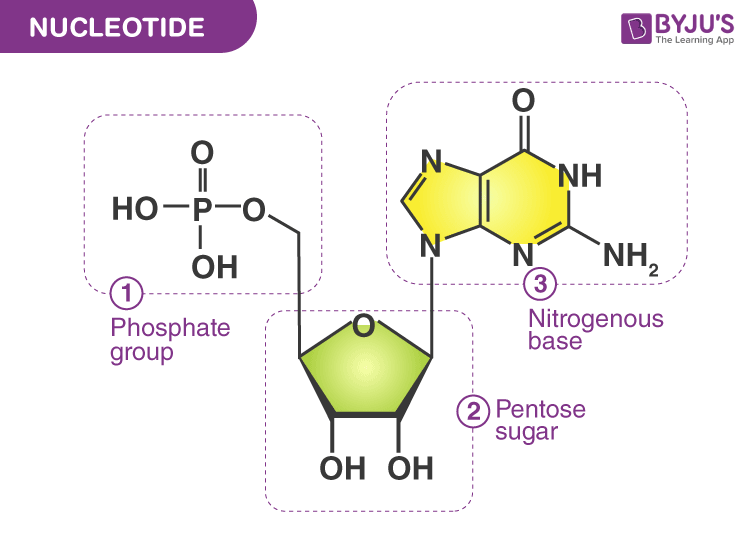
Nucleotide: Structure, Examples and Function
Explanation of 3 Parts of a Nucleotide and Nucleotide Examples - HoneyReads Within the 3 parts of a nucleotide, there are five types of nucleotide bases which are: Adenine (A), Cytosine (C), Guanine (G), Thymine (T) and Uracil (U). When they are combined with sugar, they form nucleotide adenosine, cytidine, guanosine, thymidine, and uridine. 1. Adenine

Nucleotide Structure, Parts & Function | What is a Nucleotide ...
What are the 3 parts of a nucleotide look like? - TeachersCollegesj DNA and RNA are made up of monomers known as nucleotides. The nucleotides combine with each other to form a polynucleotide, DNA or RNA. Each nucleotide is made up of three components: a nitrogenous base, a pentose (five-carbon) sugar, and a phosphate group (Figure 1). What does a nucleotide consist of?
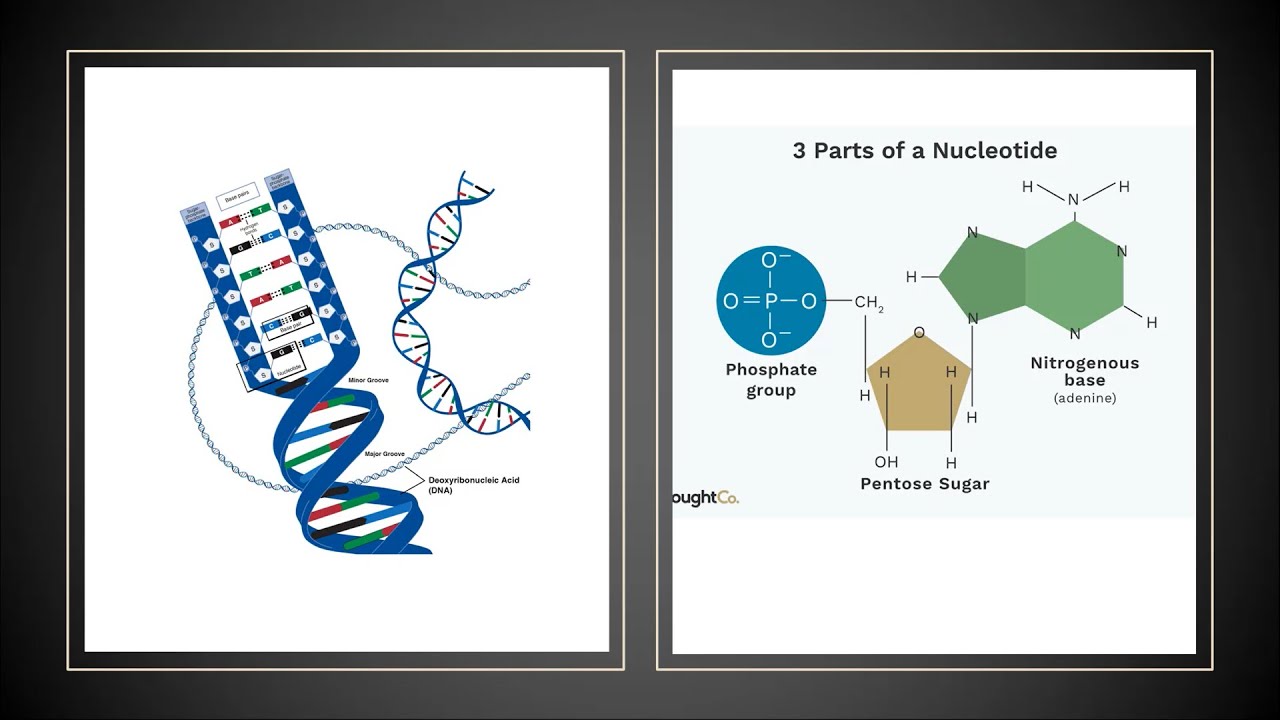
Structures And Functions of Nucleic Acids
What are the 3 parts of a Nucleotide? - Answers The three parts of a nucleotide is the deoxyribose, the nitrogen base, and the phosphate group. People also asked. Study Guides . Genetics. Created By Heath Smitham. 3.8 ★ ★ ★ ☆ 177 ...
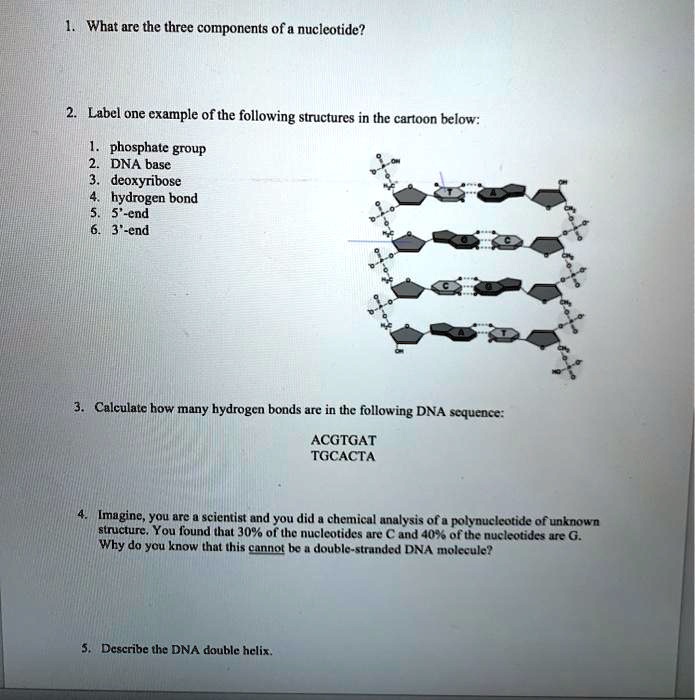
SOLVED: What are the three components of 4 nucleotide? Label ...
Home Page: American Journal of Obstetrics & Gynecology Apr 02, 2021 · AJOG's Editors have active research programs and, on occasion, publish work in the Journal. Editor/authors are masked to the peer review process and editorial decision-making of their own work and are not able to access this work in …

What are the three parts of RNA Nucleotide? Which are the bonds in RNA Nucleotide?
Nucleotide - Genome Oct 11, 2022 · A nucleotide is the basic building block of nucleic acids (RNA and DNA). A nucleotide consists of a sugar molecule (either ribose in RNA or deoxyribose in DNA) attached to a phosphate group and a nitrogen-containing base. The bases used in DNA are adenine (A), cytosine (C), guanine (G) and thymine (T). In RNA, the base uracil (U) takes the ...
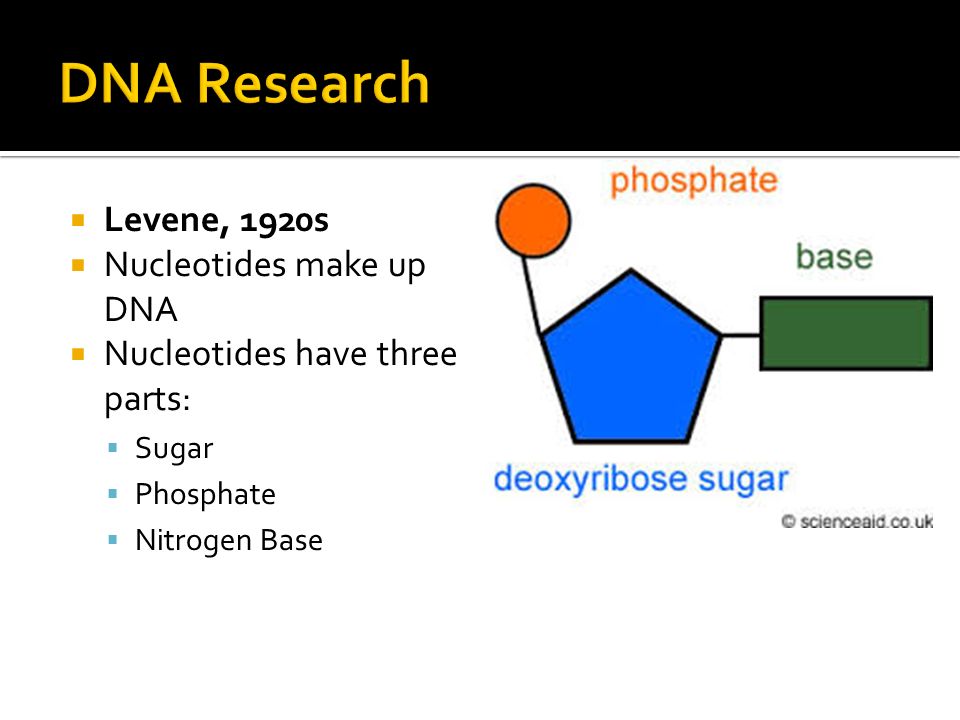
Levene, 1920s Nucleotides make up DNA Nucleotides have ...
Why are the three parts of a nucleotide? Explained by FAQ Blog Which of the 3 parts of a nucleotide helps determine the code or sequence of a gene? Each nucleotide contains one of four nitrogen-containing bases: adenine (A), thymine (T), cytosine (C) and guanine (G). The sequence of these bases constitutes the genetic code - that specifies the order and number of amino acids in a protein.
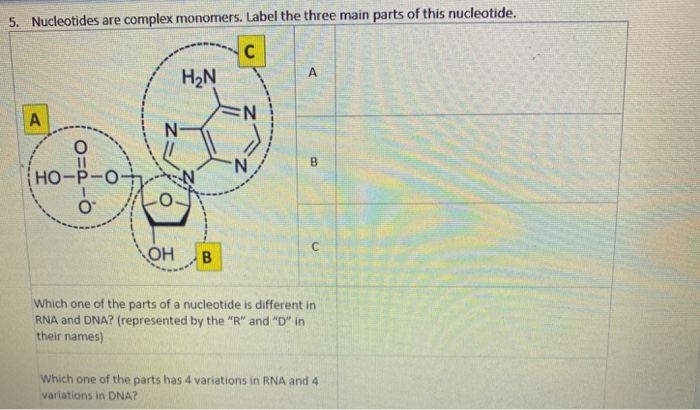
Solved 5. Nucleotides are complex monomers. Label the three ...
TOP 9 what are the 3 parts that make up a nucleotide BEST and NEWEST You are wondering about the question what are the 3 parts that make up a nucleotide but currently there is no answer, so let kienthuctudonghoa.com summarize and list the top articles with the question. answer the question what are the 3 parts that make up a nucleotide, which will help you get the most accurate answer. The following article hopes to help you make more suitable choices and get ...

What are the three components of a single nucleotide? - Quora
› what-are-the-parts-of3 Parts of a Nucleotide and How They Are Connected - ThoughtCo Jan 24, 2020 · A free nucleotide may have one, two, or three phosphate groups attached as a chain to the 5-carbon of the sugar. When nucleotides connect to form DNA or RNA, the phosphate of one nucleotide attaches via a phosphodiester bond to the 3-carbon of the sugar of the next nucleotide, forming the sugar-phosphate backbone of the nucleic acid .

Structure of Nucleic Acids | Biology for Non-Majors I
Structure of dna nucleotide - rwstou.bsc-apolda.de 2022. 9. 15. · The DNA polymerase can add a nucleotide to the pre-existing 3-OH group only. Modern formation from Greek ἄλλος állos other is a variation of the same sequence of nucleotides at the same place on a long DNA molecule as described in leading textbooks on genetics and evolution. Each nucleotide monomer is built from three simple molecular parts: a sugar, a phosphate group ...
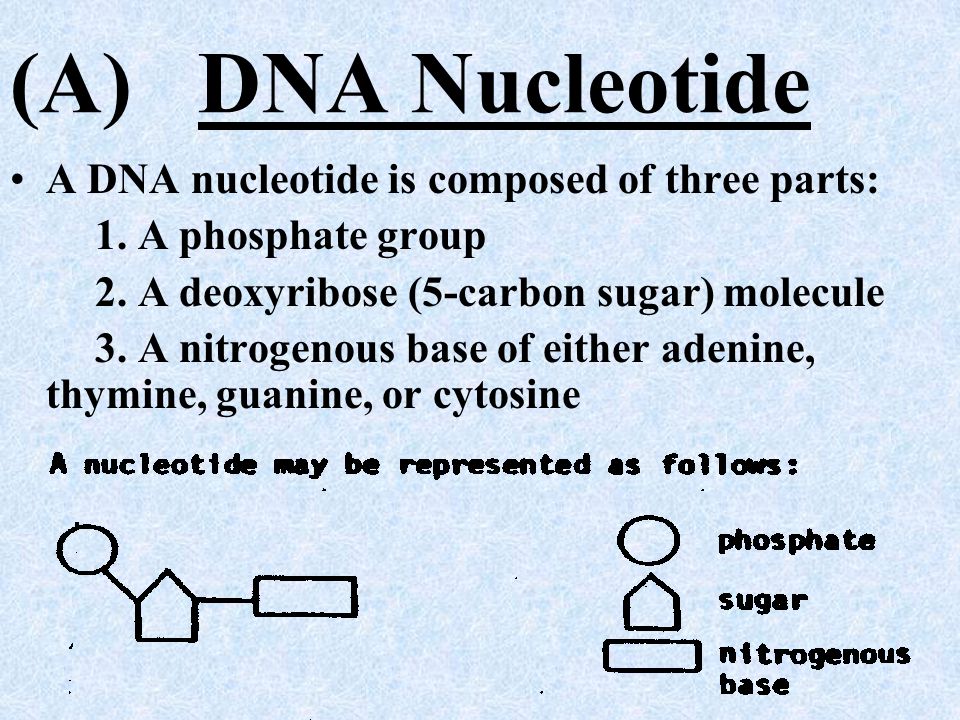
Chapter 12:DNA and RNA (Molecular Genetics). - ppt video ...
What Are The Three Parts Of An Rna Nucleotide » Theblogy.com 13 Which RNA nucleotide corresponds to the A nucleotide of DNA? 14 Nucleic acids - DNA and RNA structure; 15 What are adjacent nucleotides in an RNA chain are held together by? 16 DNA vs RNA (Updated) 17 What is a nucleotide What are the three parts of a nucleotide How is a nucleotide DNA different from a ribonucleotide RNA )?
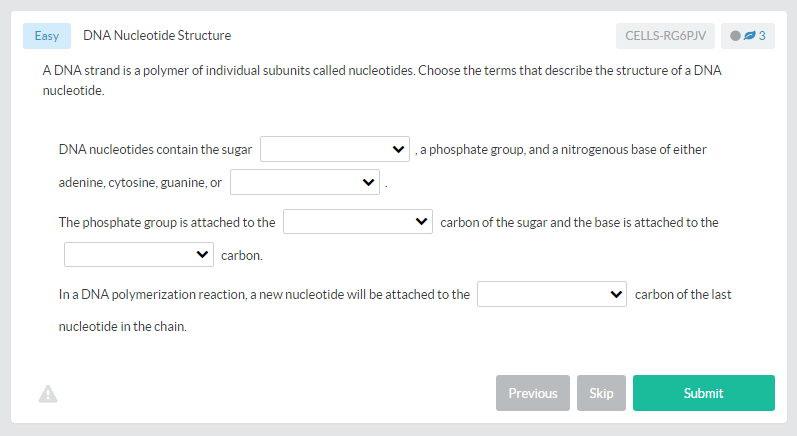
What are the Three Parts of a Nucleotide? | Albert.io
Browse Articles | Nature Oct 10, 2022 · A large genome-wide association study of more than 5 million individuals reveals that 12,111 single-nucleotide polymorphisms account for nearly all the heritability of height attributable to ...

What Are the Three Parts of a Nucleotide?
Protein - Wikipedia Proteins are assembled from amino acids using information encoded in genes. Each protein has its own unique amino acid sequence that is specified by the nucleotide sequence of the gene encoding this protein. The genetic code is a set of three-nucleotide sets called codons and each three-nucleotide combination designates an amino acid, for example AUG …
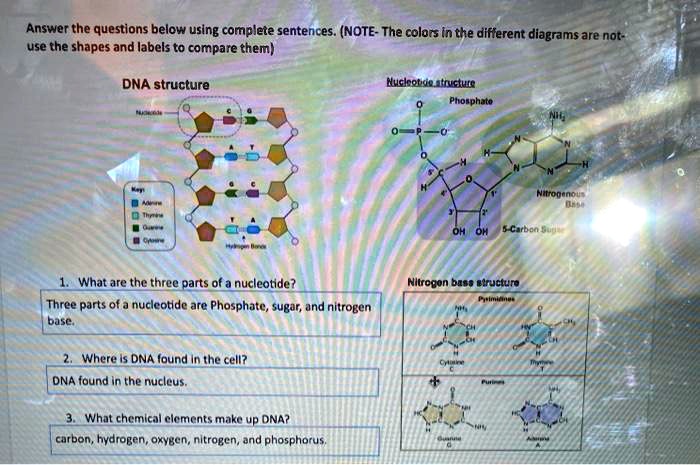
SOLVED: Answer the questions below using complete sentences ...
Answered: What are the 3 parts of a nucleotide? | bartleby What are the 3 parts of a nucleotide? Question. What are the 3 parts of a nucleotide? ...
/what-are-the-parts-of-nucleotide-606385-FINAL-5b76fa94c9e77c0025543061.png)
3 Parts of a Nucleotide and How They Are Connected
What are the three parts of a nucleotide? - AssignmentGeek A. Answer: Each nucleotide consists of the following parts: Phosphate group. Pentose sugar. Nitrogenous base (adenine) Biology.

The monomer of a Nucleic Acid is a nucleotide. What are the 3 ...
en.wikipedia.org › wiki › Base_pairBase pair - Wikipedia An unnatural base pair (UBP) is a designed subunit (or nucleobase) of DNA which is created in a laboratory and does not occur in nature. DNA sequences have been described which use newly created nucleobases to form a third base pair, in addition to the two base pairs found in nature, A-T (adenine – thymine) and G-C (guanine – cytosine).

Topic 3.3: DNA Structure. Assessment Statements 3.3.1 ...
Nucleotide - Definition, Structure (3 Parts), Examples & Function A nucleotide is made up of three parts: a phosphate group, a 5-carbon sugar, and a nitrogenous base. The four nitrogenous bases in DNA are adenine, cytosine, guanine, and thymine. RNA contains uracil, instead of thymine. A nucleotide within a chain makes up the genetic material of all known living things.
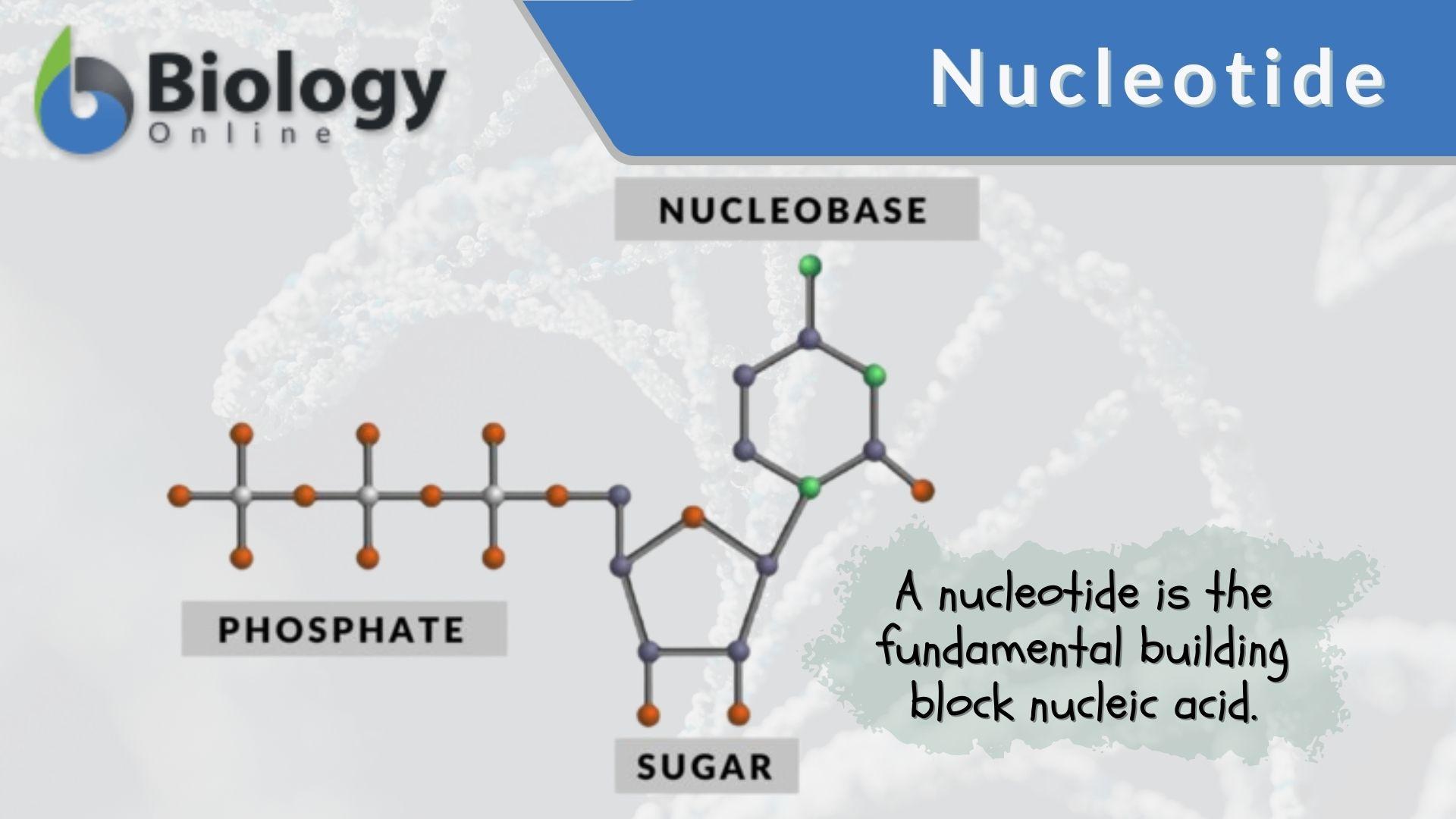
Nucleotide Definition and Examples - Biology Online Dictionary
What Are The Three Parts Of A Nucleotide | Jacks Of Science Each nucleotide is composed of three parts: a sugar, a phosphate, and a nitrogen-containing base. The sugar molecule can be either ribose or deoxyribose, and the phosphate group is bonded to the sugar via a phosphodiester bond. The nitrogen-containing base is attached to the sugar via a nitrogenous base pair. What is a phosphate group?

Nucleic Acids | Biology
What Are the 3 Parts of a Nucleotide.docx - What Are the 3... Both deoxyribonucleic acid (DNA) and ribonucleic acid (RNA) are made up of nucleotides which consist of three parts: 1. Nitrogenous Base Purines and pyrimidines are the two categories of nitrogenous bases. Adenine and guanine are purines. Cytosine, thymine, and uracil are pyrimidines. In DNA, the bases are adenine (A), thymine (T), guanine (G), and cytosine (C).

What Are the Three Parts of a Nucleotide?
Base pair - Wikipedia A base pair (bp) is a fundamental unit of double-stranded nucleic acids consisting of two nucleobases bound to each other by hydrogen bonds.They form the building blocks of the DNA double helix and contribute to the folded structure of both DNA and RNA.Dictated by specific hydrogen bonding patterns, "Watson–Crick" (or "Watson–Crick–Franklin") base pairs …
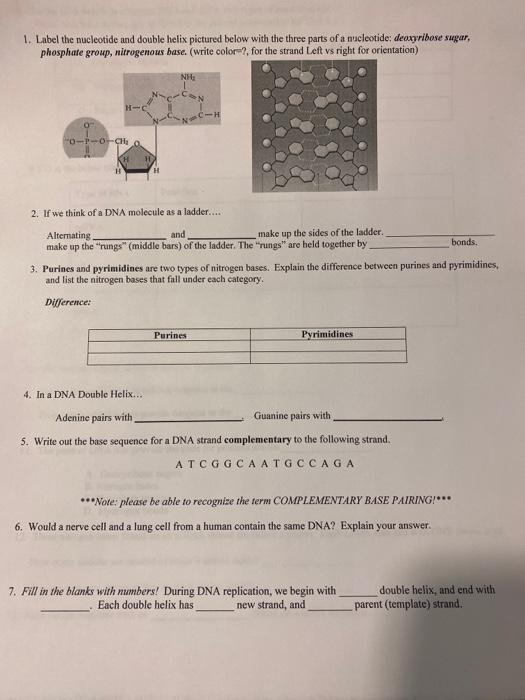
Solved 1. Label the nucleotide and double helix pictured ...
:max_bytes(150000):strip_icc()/GettyImages-1141680075-669f63da324a4cc2a6f8bb0da7d9de7c.jpg)
3 Parts of a Nucleotide and How They Are Connected

What Is DNA?
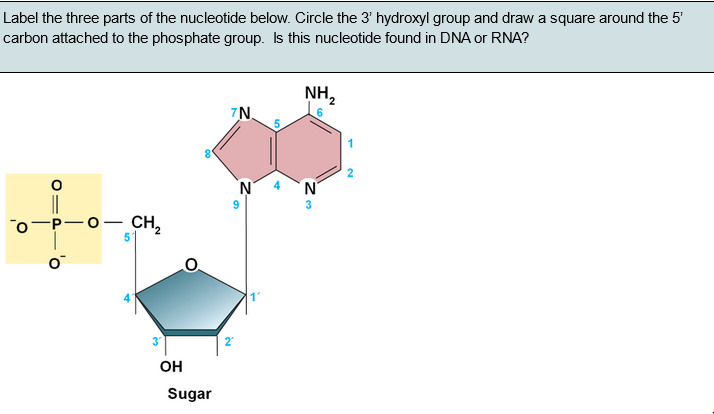
Solved Label the three parts of the nucleotide below. Circle ...

1. What are the 3 components of a Nucleotide? 2. What is ...

HEALTH – LAS VEGAS REVIEWS AND VIEWS

DNA - Biological Molecules Ep 1 - Zoë Huggett Tutorials

Warm Up 4 2/10 What are the 3 parts of a nucleotide? - ppt ...
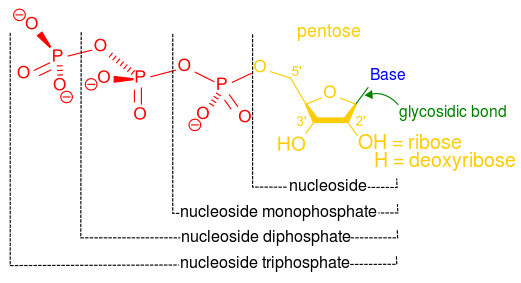
What are the Three Parts of a Nucleotide? | Albert.io

what are the three parts of a nucleotide?

1. What are the 3 components of a Nucleotide? 2. What is ...
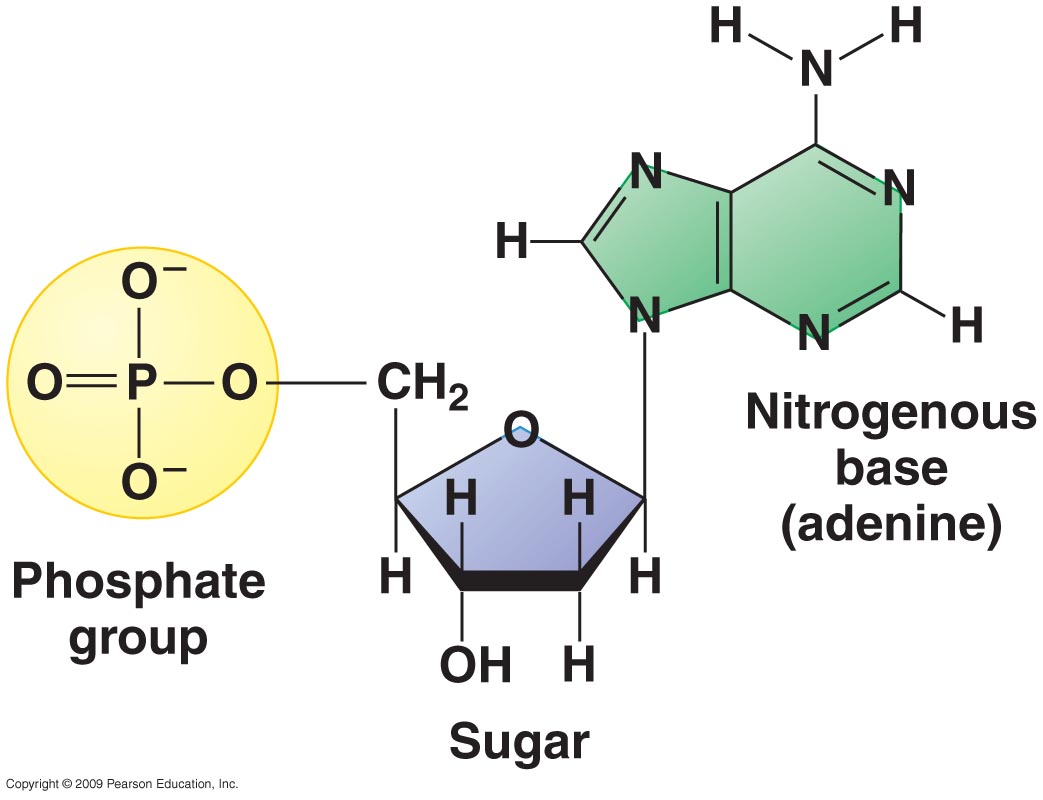
What are the three parts of a nucleotide? | Socratic
What are the three components of a single nucleotide? - Quora
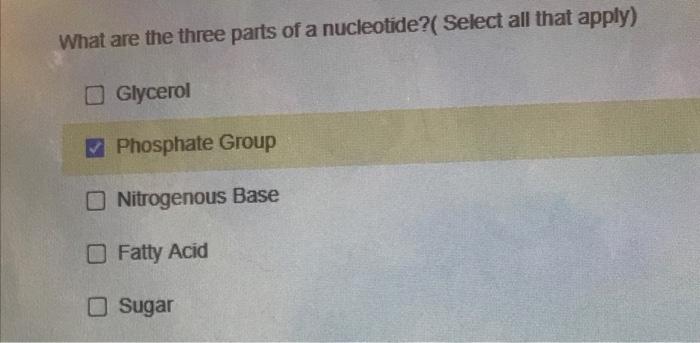
Solved What are the three parts of a nucleotide?( Select all ...
:max_bytes(150000):strip_icc()/DNA_model_helix-57d18cb15f9b5829f43818e7.jpg)
3 Parts of a Nucleotide and How They Are Connected
:max_bytes(150000):strip_icc()/dna-versus-rna-608191_sketch_Final-54acdd8f8af04c73817e8811c32905fa.png)
3 Parts of a Nucleotide and How They Are Connected
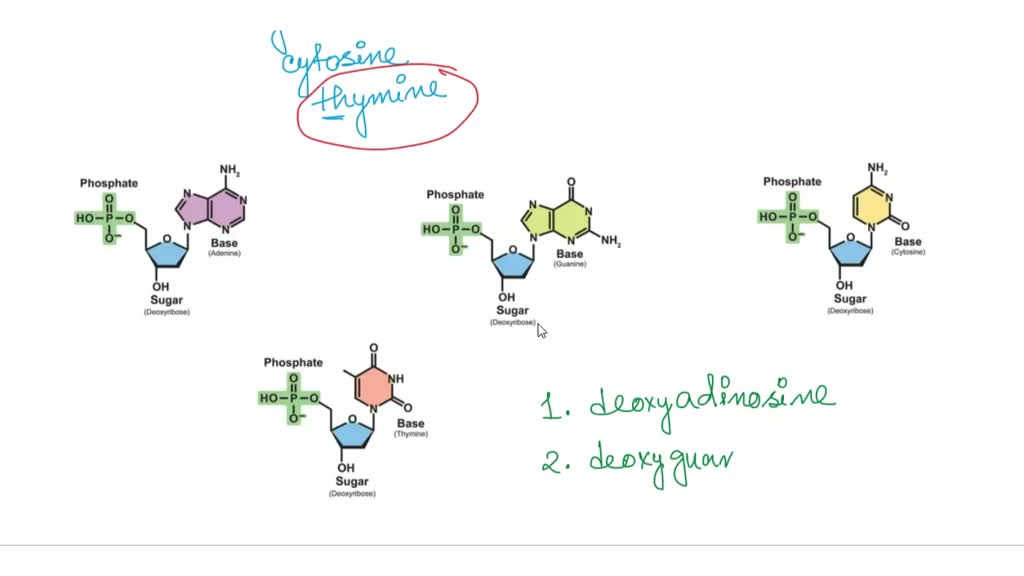
what are the three components of 4 nucleotide label one example of the following structures in the cartoon below phosphale group dna base deoxyribose hydrogen bond end 3 end calculate how ma 18014

What are the Three Parts of a Nucleotide? | Albert.io

Diagram of a nucleotide | Download Scientific Diagram

13.06.01: Imagine the Unimaginable Harnessing the Power of ...
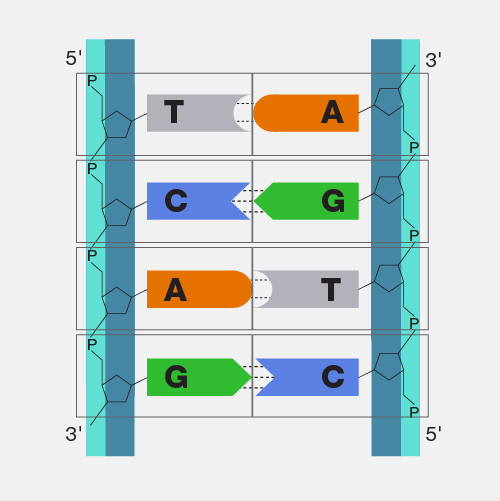
Nucleotide
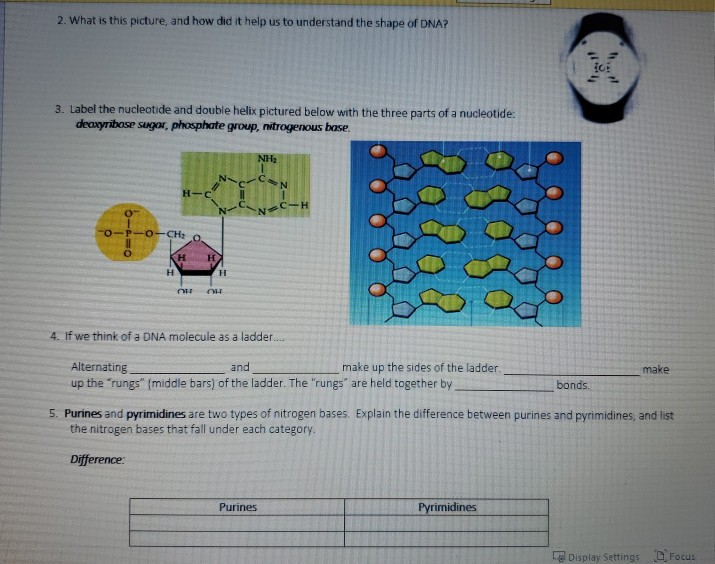
Solved 2. What is this picture, and how did it help us to ...
:max_bytes(150000):strip_icc()/ribonucleic-acid-conceptual-artwork-97358545-58a0f8273df78c475835f134.jpg)
3 Parts of a Nucleotide and How They Are Connected

The three components of a nucleotide are ...
Post a Comment for "45 what are the three parts to a nucleotide"